The news out of China, that a dinosaur tail preserved in amber was found, may not seem like a big deal, thanks to Jurassic Park, but honestly – it is.
For a long time, scientists have proposed that dinosaurs are more than the scaly jumbo-sized reptiles we once thought they were. Logic dictated, to many, that animals that large could not be poikilotherms like the reptiles living on our planet today. You simply can’t keep a body that size mobile and, well, alive on the sluggish metabolism of what people used to call “cold-blooded” animals.
With the acceptance of the fact that dinosaurs were probably homeotherms like us, and the evidence that their lineage gave rise to both mammals and birds, people started to question whether our ideas about their appearance were correct. Scales did, in fact, give rise to both feathers and hair. The basic material, keratin, is a fairly universal structural protein among vertebrates. It wasn’t long before people recognized that the possibility of feathered dinosaurs was high.
Until recent decades, the longest-standing evidence came from a single fossil found in Germany: Archaeopteryx. Traces of feathers marked out in the stone came with distinct aspects of reptilian bodies. Birds descended from a group of dinosaurs called theropods, and that relationship was always explained in the past through anatomy: reptile-like scales and claws on the legs and feet, an eye structure reminiscent of reptiles… and now, add feathers to that list.
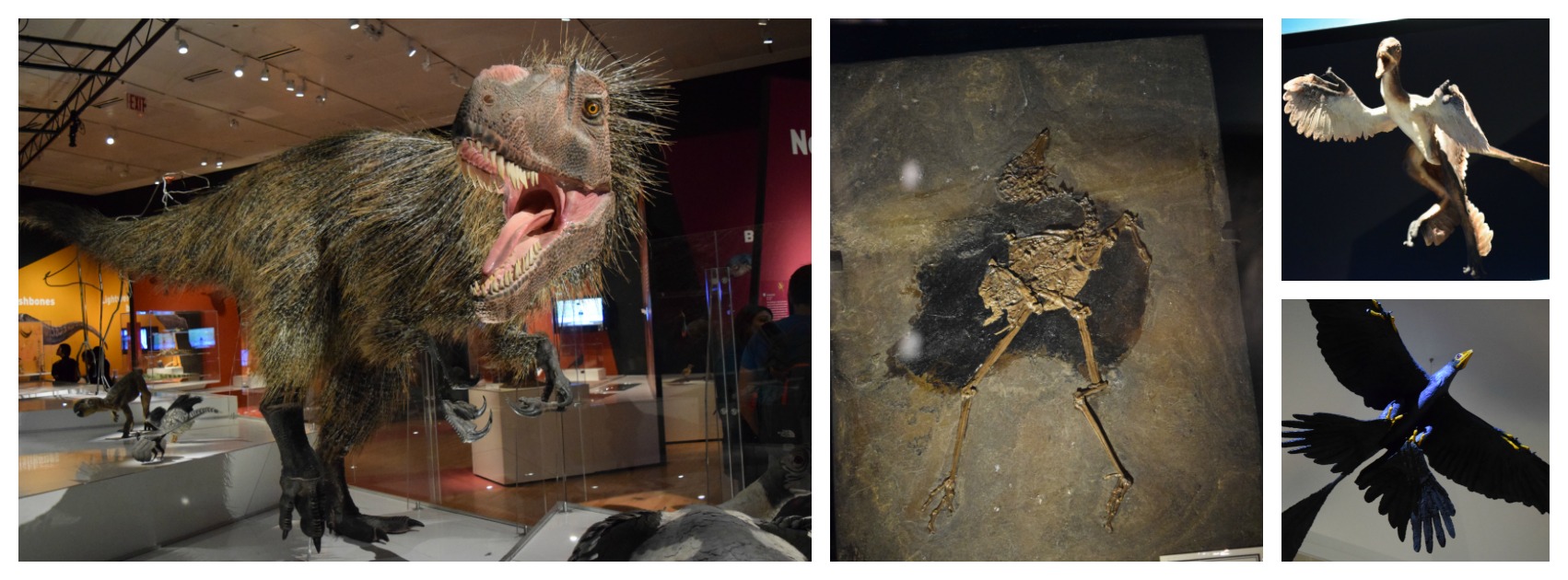
I had the pleasure of visiting the American Museum of Natural History in New York City recently, and saw a special exhibit dedicated to the origin of birds. Dinosaurs Among Us had amazing reconstructions and fossils: A complete clutch of dinosaur eggs showing the nesting pattern, reconstructed birds in flight, and taxidermy of modern day birds, including the extinct dodo and passenger pigeon. A selection of my photos from the exhibit is below.

 Stosich Science