Grade Nine essential Science students are benefitting from a totally re-vamped course this year! A lot of hard work went into developing a brand new way of teaching essential science. The model is highly differentiated, and is based on the principle that students should be able to choose activities that motivate them according to their interests, and give them success based on their strengths. The teacher acts as guide and mentor in this model.
Here’s how it works:
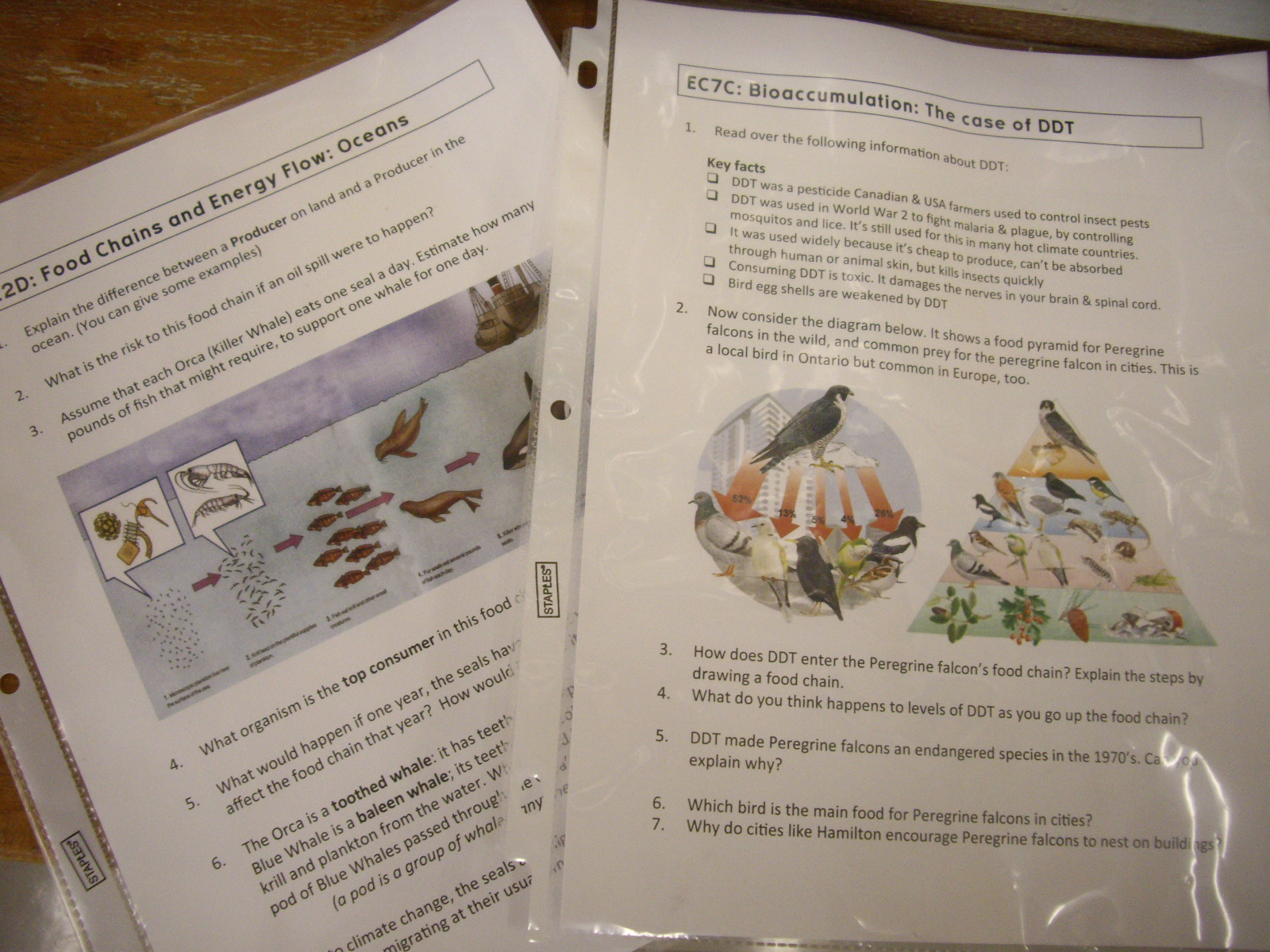
Activity cards from the Ecology Unit
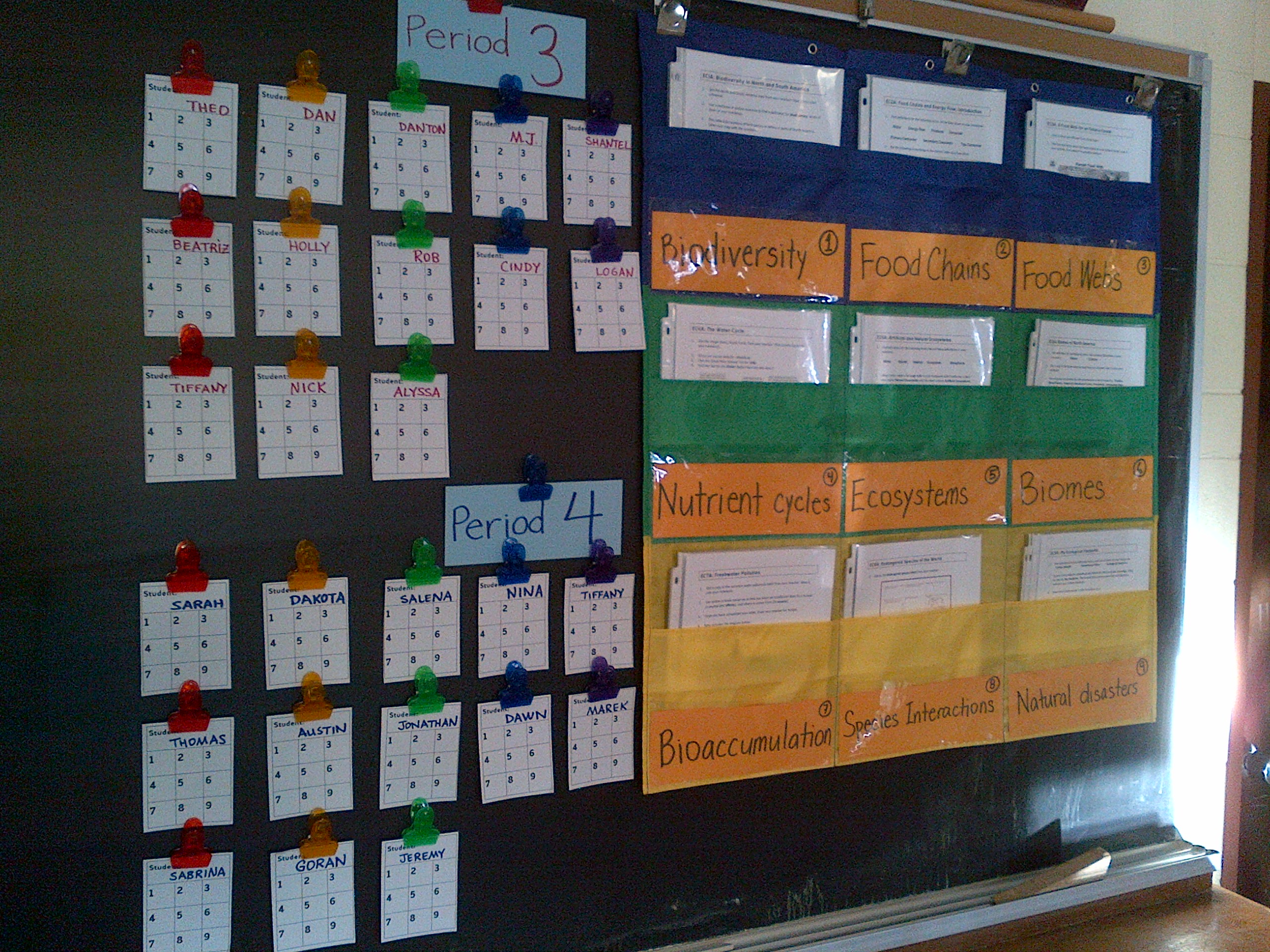
Activity cards are organized by theme. Students track progress individually.
The SNC1L1 course has four units that are in line with the topics in our remaining grade nine courses: Ecology, Astronomy, Chemistry, and Electricity. Each unit has been divided into 9 themes. For each theme, a minimum of 3, and in some cases 4, activities have been developed with the students’ skills and abilities in mind. The activities are all found on activity cards that are displayed in the lab, in a pocket chart. Students select from the diverse activities each day. The activities cover a range of formats, so that there is guaranteed to be at least one activity (but hopefully more) that the student can look at and think, “hey, this is neat!” or “Yes, I can do this!”. There are activities that involved videos and online simulations; classic lab experiments; games that teach a particular principle from a topic; visual activities, like posters and models; activities that rely on math, or are “math light”; and activities that involve reading and writing, of course. All of the activities are intended to enhance student literacy skills. As an added support, a Word Wall of vocabulary cards is also on display in the classroom. It’s a resource that students can turn to any time, to clarify what they’re reading or to find a definition of a term.
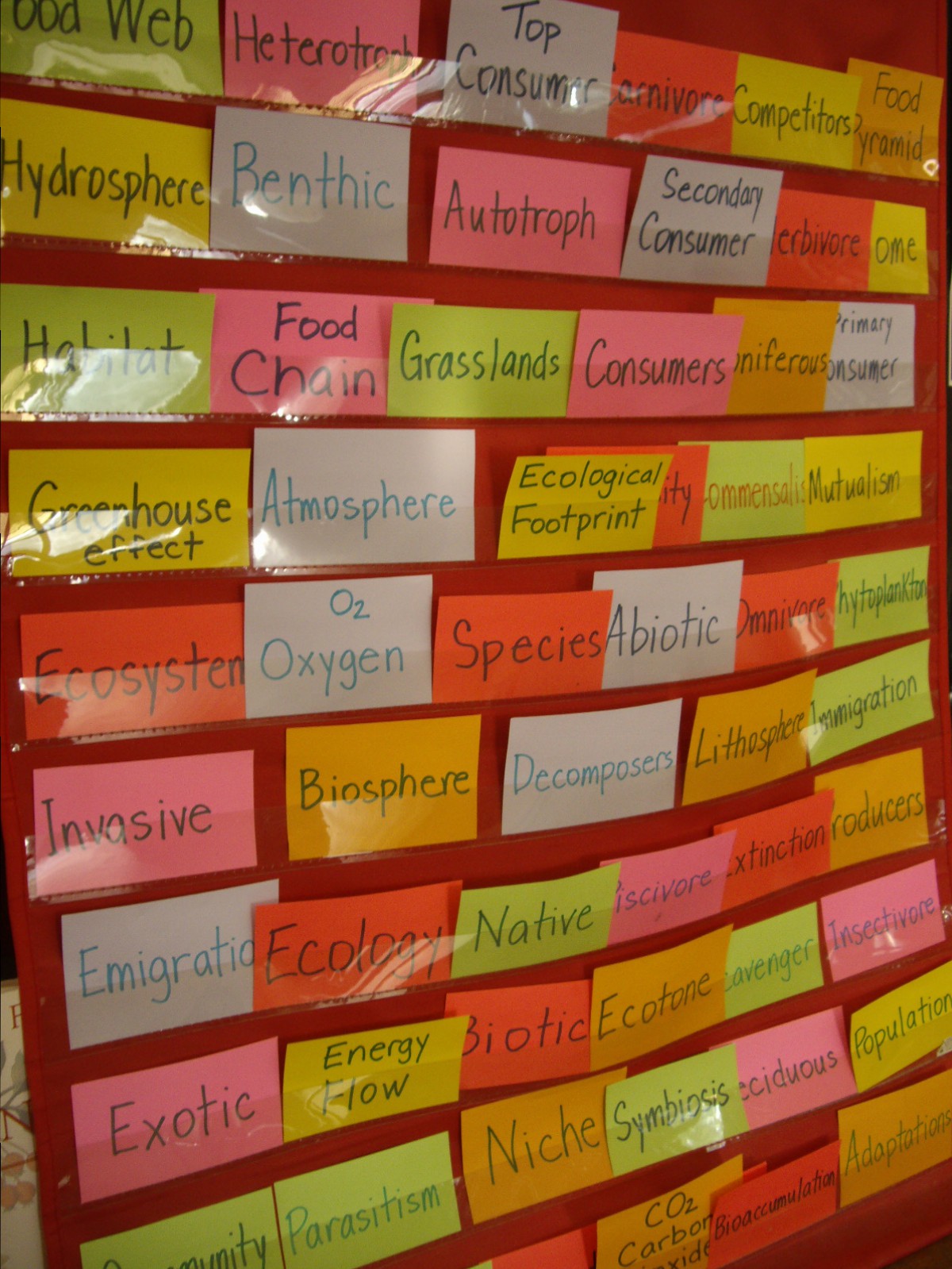
Word Wall: each card has a definition on the back.
The structure of the course requires students to complete at least one activity from each of the nine themes in each unit, in order to ensure that they get a grasp of the whole unit topic and that they can demonstrate an overall knowledge of the unit topic. Beyond the nine, students are required to complete up to six more activities, according to their abilities, for a total of fifteen activities. This allows them to revisit themes they enjoyed, or do more than one type of activity. For example, the kid that doesn’t enjoy cut & paste activities can avoid them entirely, as long as he/she completes all themes. On the other hand, a student who really likes that type of activity could do up to 3 per unit. If a student’s weakness is numeracy and math skills, they can do the minimum – perhaps one activity – and avoid others; yet, a teacher working with the student might encourage him/her to hone those skills by trying more. Students track their own progress on personalized tracking grids, updated daily.
Student learning needs are met through accommodations in their IEP’s, and the helpful staff in Resource and in the Student Engagement Centre (Rm 106) are already making great strides with both classes – my heartfelt thanks to all of them! Both Resource and Rm 106 have a complete set of activities and vocabulary waiting, so students will never be without an activity card, wherever they are.
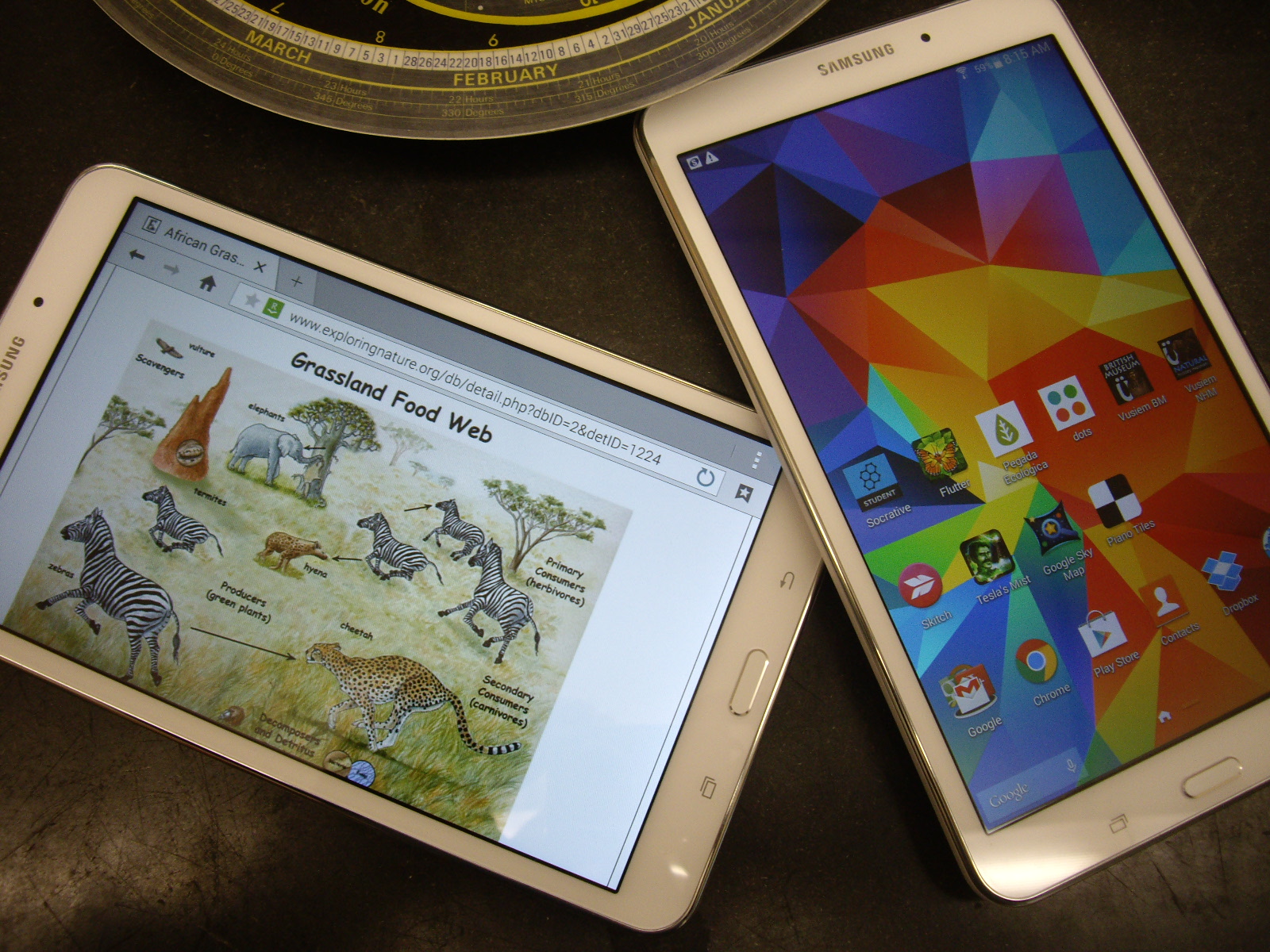
Tablets let students access information immediately.
Finally, the activities are enhanced by the computers and Chromebooks in our Learning Commons, as well as six dedicated Samsung Tab 4 tablets purchased especially to support SNC1L1. The students are finding them easy to use, motivating and engaging. Already, many are improving their research skills through better choices while searching. No more frustration if a student has difficulties typing in search terms; the tablet has a voice-activated search function. All you have to say is “OK, Google… ” followed by your request (eg., “find me a map of North America” or “what is the Water Cycle?”) and the results pop up. The tablets also make use of the same Google Apps that were integrated into many of our other Science courses last year, the result of our board’s enterprise agreement with Google. Popular apps so far have included Google Sky Map, Circuit Builder, Skitch, and even a few Science-themed games.
The results are promising, and we’re hopeful that this new approach will achieve its main goal: to improve literacy, numeracy and science awareness in our essential classes, and make science an enjoyable and memorable experience for students.
– A. Stosich
 Stosich Science